
Vases are no longer just for holding flowers, as designers are using them to add visual presence to furniture in living rooms, dining rooms, entryways, and media walls.
Sideboards, credenzas, consoles, and display cabinets provide ideal surfaces for decorative styling, with arrangements relying on height, scale, texture, color, or shape to transform ordinary furniture into a focal point.
A well-placed vase can give furniture more visual presence.
Designers use different heights to create a staggered composition while muted finishes keep attention on shape and proportion rather than color, as seen in examples where large stone-look vases sit on a floating media console beside a television.
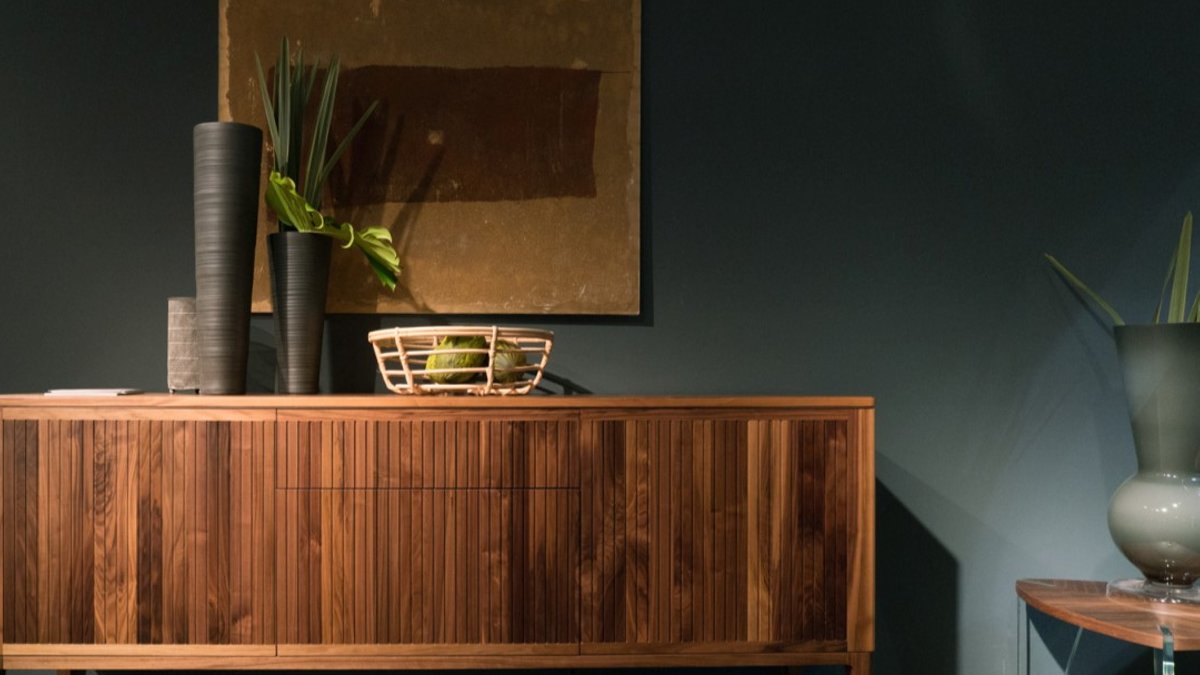
Tall black vases and a woven basket sit above a fluted wood sideboard finished in rich walnut tones, introducing texture that contrasts with smooth decorative accessories, and they create a strong visual presence.
Vertical grooves across cabinet fronts introduce texture, and dark vessels draw attention upward, helping anchor artwork mounted above, which is a key element in the overall design.
A pair of oversized ceramic vessels occupies the center position on a solid wood dining table, creating a strong focal point across a large surface, and the rounded forms echo geometric pendant lights suspended overhead.
Similar shapes and matching finishes create cohesion without requiring additional table décor, and matte black storage supports a collection of sculptural vessels, geometric décor pieces, and accent lighting, making them a key part of the room’s design.
Dark finishes across furniture and accessories create a unified composition.
Contrast comes from silhouettes and materials rather than bold color changes, and ceramic vessels, framed artwork, and foliage cover a long wood console positioned against a deep-toned wall, creating a unique display.
Plant foliage introduces scale changes that break up hard edges, and reflective silver vases sit above a woven-front cabinet framed in natural wood, with contrasting finishes placing equal emphasis on craftsmanship and decorative styling, much like a commercial roofing contractor would consider various materials.
Textured cabinet doors provide visual depth even before accessories are added, and metallic surfaces reflect surrounding colors and lighting, helping display arrangements change throughout the day, which is similar to how equipment can be used in different ways, such as putting equipment to work on the weekend.
Tall ceramic and glass vases occupy a round glass table positioned beside seating, creating a layered arrangement without crowding the tabletop, and they create a sense of depth.
Yellow and gray ceramic vases sit in front of a decorative framed mirror, with branches extending beyond the mirror frame, creating a composition that reaches into surrounding wall space, and the mirror becomes part of the arrangement rather than remaining a separate decorative piece, much like a Samsung Full HD TV would be a central part of a room’s entertainment system.
White ceramic vases and floral stems rest above an ornate dresser finished with decorative carvings and gold accents, with a matching mirror strengthening symmetry across the display, and the curved furniture details pair well with rounded vessel shapes.
A collection of black, cream, and charcoal vessels occupies a simple display surface without flowers or greenery, with each piece relying on silhouette and finish to attract attention, and they create a sense of simplicity.
Strong shapes create interest even in monochrome palettes, and the arrangement demonstrates how decorative vessels can function as standalone art objects, which is a key aspect of their design.


